
100 GSM vs 150 GSM vs 200 GSM Cotton: Which Is Best for Indian Summers?
When shopping for cotton clothes, you may have come across a term that sounds more technical than fashionable: GSM.
You may see fabric described as 100 GSM, 150 GSM, 180 GSM, 200 GSM or even higher. But what does GSM actually mean? Does higher GSM mean better cotton? And most importantly, which GSM is best for India’s hot and humid summers?
The answer isn’t simply “the lower, the better.”
GSM tells you the weight of the fabric, but comfort depends on several other factors, including the weave, fibre, construction, finishing and garment design.
In this guide, we’ll compare 100 GSM vs 150 GSM vs 200 GSM cotton and help you understand what to look for when buying cotton kurtis, co-ord sets and other summer clothing.
What Does GSM Mean in Cotton Fabric?
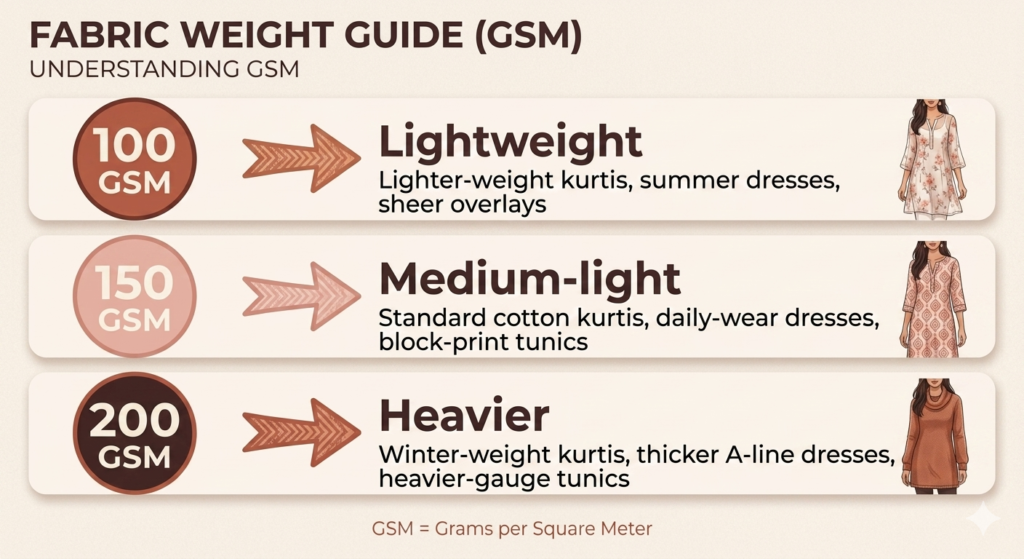
GSM stands for Grams per Square Metre.
It tells you how much a square metre of fabric weighs.
For example:
- 100 GSM = approximately 100 grams per square metre
- 150 GSM = approximately 150 grams per square metre
- 200 GSM = approximately 200 grams per square metre
In simple terms, as GSM increases, the fabric generally becomes heavier. However, GSM should not be treated as a direct measure of fabric quality.
A 200 GSM cotton fabric isn’t automatically better than a 100 GSM cotton fabric. They can simply be designed for different purposes.
When shopping for cotton clothing, you may have come across terms like 100 GSM, 150 GSM and 200 GSM. But what do these numbers actually mean? In this guide, we compare 100 GSM vs 150 GSM vs 200 GSM cotton to understand their thickness, breathability, comfort and suitability for Indian summers.
Why Does GSM Matter for Summer Clothing?
When you’re dressing for an Indian summer, fabric weight can influence how an outfit feels.
A lighter fabric may feel airy and easy to wear, while a heavier fabric may provide more structure and coverage.
But there is an important catch.
Fabric weight and breathability are not exactly the same thing.
The weave and construction of the fabric can influence airflow and how the material feels against the body. Finishing and garment construction can also affect the final feel.
That’s why simply searching for the lowest GSM fabric isn’t always the best way to choose summer clothing.
100 GSM Cotton: Lightweight and Airy
100 GSM cotton sits on the lighter side of the comparison.
Because the fabric contains less material by weight per square metre, it can feel light and comfortable, particularly when the construction is open and breathable.
Advantages of 100 GSM Cotton
- Very lightweight
- Comfortable in hot weather
- Easy to wear for long hours
- Can feel airy and soft
- Suitable for relaxed summer garments
Things to Consider
Very lightweight cotton can sometimes have less body or coverage than a heavier fabric. Depending on the weave and colour, it may also be more transparent.
So, 100 GSM isn’t automatically the best choice for every garment.
For example, a lightweight cotton fabric may be excellent for a loose summer top but may require a different construction or lining when used for another type of garment.
Best suited for:
- Very lightweight summer tops
- Airy casual clothing
- Relaxed silhouettes
- Extremely hot weather
- Garments where lightness is a priority
150 GSM Cotton: The Summer Sweet Spot?
Now we come to 150 GSM cotton.
For many everyday garments, this weight can offer a useful balance between lightness, coverage and structure.
It doesn’t necessarily feel as delicate as very lightweight cotton, while still being comfortable enough for warm-weather clothing.
Advantages of 150 GSM Cotton
- Good balance of weight and comfort
- Better body than very lightweight fabric
- Suitable for everyday clothing
- Can provide better coverage
- Works well for structured yet comfortable silhouettes
This makes medium-light cotton particularly interesting for everyday kurtis and co-ord sets.
For Indian summers, where you may need to move between outdoor heat, offices, shopping areas and air-conditioned spaces, having a fabric that balances comfort and structure can be practical.
Best suited for:
- Cotton kurtis
- Co-ord sets
- Casual shirts
- Everyday summer wear
- Office-friendly cotton outfits
200 GSM Cotton: Heavier, Structured and More Substantial
At around 200 GSM, cotton fabric is considerably heavier than 100 GSM fabric.
This doesn’t mean it is uncomfortable. In fact, heavier cotton can provide benefits such as greater body, structure and coverage.
However, for extremely hot and humid conditions, you may prefer a lighter construction depending on the garment.
Advantages of 200 GSM Cotton
- More substantial fabric feel
- Greater structure
- Better coverage in many constructions
- Suitable for garments where durability and body are important
- Can create a more structured silhouette
Things to Consider
A 200 GSM fabric can feel warmer than a lighter fabric, particularly if the weave is dense and the garment has a close-fitting construction.
Therefore, if your primary concern is staying comfortable during peak summer heat, don’t choose a fabric based on GSM alone.
Best suited for:
- Structured cotton garments
- Heavier casual clothing
- Garments where coverage is important
- Cooler weather
- Styles requiring more fabric body
100 GSM vs 150 GSM vs 200 GSM Cotton: Quick Comparison
| Feature | 100 GSM | 150 GSM | 200 GSM |
|---|---|---|---|
| Fabric weight | Very light | Medium-light | Heavier |
| Feel | Airy and lightweight | Balanced | More substantial |
| Structure | Low | Moderate | Higher |
| Coverage | Can be lower | Generally better | Generally higher |
| Hot-weather comfort | Excellent when construction is breathable | Very good | Depends on construction |
| Best for | Very lightweight clothing | Everyday summer wear | Structured garments |
Important: These are practical generalisations, not universal rules. Two fabrics with the same GSM can feel quite different because weave, yarn, fibre characteristics and finishing can vary.
Does Higher GSM Mean Better Cotton?
No.
This is one of the biggest misconceptions about fabric GSM.
GSM measures fabric weight, not overall quality.
Think about it this way:
Would you say a winter jacket is “better quality” than a cotton summer shirt simply because it is heavier?
Of course not.
They are designed for completely different purposes.
Similarly, a 100 GSM cotton fabric may be exactly what you want for a lightweight summer garment, while a 200 GSM cotton fabric may be preferable when you want more structure or coverage.
When evaluating cotton clothing, look beyond GSM and consider:
- Fibre composition
- Yarn quality
- Weave
- Fabric construction
- Finishing
- Colourfastness
- Shrinkage
- Stitching quality
- Garment construction
- Intended use
CottonWorks notes that textile performance can be affected by factors including fibre, yarn, construction, wet processing, finishing and garment-care practices.

So, Which GSM Is Best for Indian Summers?
If you’re shopping specifically for summer clothing, there isn’t one magic GSM number that works for every garment.
Instead, think about what you want from the outfit.
Choose around 100 GSM when:
You want something extremely lightweight and airy, particularly for very hot conditions and relaxed silhouettes.
Choose around 150 GSM when:
You want a balance of comfort, coverage and structure for everyday clothing.
For many women, this can be a practical range to look for when shopping for cotton kurtis and co-ord sets—provided the weave and construction are also suitable for summer.
Consider around 200 GSM when:
You want a more substantial fabric with greater body, structure or coverage and don’t mind a heavier feel.
GSM Isn’t the Only Thing That Makes Cotton Comfortable
Imagine two cotton fabrics:
Fabric A: 120 GSM with an open, breathable construction.
Fabric B: 120 GSM with a dense construction.
They have the same GSM.
But they may not feel the same when you wear them.
That’s because GSM tells you the weight, not the complete behaviour of the fabric.
This is why fabric shopping shouldn’t be reduced to one number.
For summer clothing, also consider:
1. Weave
The way yarns are arranged can affect the fabric’s feel, appearance and airflow.
2. Fit
A relaxed garment generally allows more room for movement and airflow than a very tight garment.
3. Colour
Light colours are often a popular choice for summer wardrobes because they create a fresh, lighter visual appearance.
4. Fabric Construction
Two cotton fabrics with similar GSM can have different textures, drape and performance depending on how they’re constructed.
5. Finishing
Finishing processes can influence the final feel, appearance and dimensional stability of cotton fabric.
What Should You Look for When Buying a Cotton Co-Ord Set?
If you’re buying a cotton co-ord set for Indian summers, don’t stop at the word “cotton.”
Use this simple checklist:
✔ Check the fabric composition
Look for clear information about the fibre content.
✔ Ask about GSM when available
GSM can help you understand the approximate weight of the fabric.
✔ Consider the weave and feel
Does the fabric feel airy, comfortable and suitable for the climate?
✔ Check the fit
Relaxed silhouettes can be particularly comfortable in hot weather.
✔ Look at the garment construction
Good stitching, finishing and construction matter just as much as fabric weight.
✔ Check care instructions
Cotton can experience dimensional changes during laundering, so following the garment’s care instructions is important. CottonWorks explains that shrinkage can be influenced by fibre, yarn, construction, processing, finishing and laundering practices.
What About Cotton Shrinkage?
This is another reason why fabric quality cannot be judged by GSM alone.
Cotton fabrics can undergo dimensional changes during processing and laundering. The amount of shrinkage can depend on the fabric’s construction, processing and finishing, as well as garment-care practices.
So when buying cotton clothing, don’t just ask:
“What GSM is this?”
Also ask:
“How has this fabric been finished and how should I care for it?”
That gives you a much better understanding of what you’re actually buying.
The Bottom Line: 100 GSM vs 150 GSM vs 200 GSM Cotton
So, which one wins?
The honest answer is: it depends on the garment.
100 GSM
Best when your priority is very lightweight, airy clothing.
150 GSM
A versatile middle ground for many everyday summer garments where you want a balance of lightness, coverage and structure.
200 GSM
Better when you want a more substantial and structured fabric and don’t mind additional weight.
But remember:
Higher GSM does not automatically mean higher quality.
For Indian summers, the best cotton clothing is not necessarily the lightest fabric you can find. What matters is the combination of fabric weight, weave, construction, fit, finishing and comfort.
Why Cotton Co-Ord Sets Work So Well for Summer
A good summer wardrobe doesn’t have to mean choosing between comfort and style.
Cotton co-ord sets make getting dressed easier because the top and bottom are already designed to work together.
You get:
- An instantly coordinated outfit
- Easy styling
- Comfortable everyday wear
- Mix-and-match possibilities
- A polished look without too much effort
If you’re still figuring out which silhouette works best for you, read our guide on How to Choose the Right Co-Ord Set for Your Body Type.
And if you’re looking for more ideas on dressing comfortably in hot and humid weather, read How to Choose Cotton Clothes for Hot and Humid Weather.

Frequently Asked Questions
Is 100 GSM cotton good for summer?
Yes. Lightweight cotton around 100 GSM can be comfortable for summer, particularly when the fabric construction is breathable. However, coverage and opacity can vary depending on the weave and colour.
Is 150 GSM cotton good for Indian summers?
150 GSM can be a practical middle ground for many everyday summer garments because it can balance lightness, coverage and structure. The actual comfort still depends on the weave and garment construction.
Is 200 GSM cotton too thick for summer?
Not necessarily. A 200 GSM cotton fabric is heavier, but whether it feels too warm depends on its construction, weave, garment design and how it is worn.
Does higher GSM mean better quality?
No. GSM measures fabric weight. It does not independently measure quality.
What GSM is best for cotton co-ord sets?
There is no single ideal GSM for every co-ord set. For lightweight everyday summer co-ords, a medium-light fabric can offer a useful balance between comfort, coverage and structure. The weave, construction and fit are equally important.
How can I tell if cotton fabric is good quality?
Look at more than GSM. Check the fibre composition, fabric construction, feel, stitching, finishing, colourfastness, shrinkage performance and care requirements.
Final Thoughts
The next time you see 100 GSM, 150 GSM or 200 GSM on a cotton fabric description, you’ll know that the number is only one part of the story.
Think of GSM as a clue, not a quality score.
For India’s hot summers, choose cotton clothing based on the complete picture: weight + weave + construction + fit + finishing + comfort.
Because ultimately, the best summer outfit isn’t the one with the perfect number on the label.
It’s the one you actually enjoy wearing all day.
At Taniroop, we believe summer fashion should feel as good as it looks. Our cotton co-ord sets and short kurtis are designed around effortless everyday style and comfort for warm-weather dressing.
Explore Taniroop’s cotton collection and find your summer favourite.